From idea to working software – typically in 2–3 weeks.
You provide the idea & sketches, we handle concept and development.
A working system for early testing & a well-founded go/no-go decision.
No IT resources of your own required – with full data sovereignty.
Not just building faster. Understanding sooner.
Senior devs instead of blind AI flight
AI accelerates the craft, but our senior engineers stay in control. Every step is checked. No loss of control, no unchecked AI black box.
Spec-driven development instead of vibe coding
We don’t code blindly. While the prototype is being built, a requirements document grows alongside it – until it is clean and complete. This becomes the foundation for the software that follows.
Test early, before bigger investments are made
The prototype can be tested with real users. This allows early feedback and course correction. The AI-supported implementation remains structured and under the responsibility of our senior engineers throughout.
An actionable, consistent specification
“…need something like a dashboard for the solar power, show consumption and somehow bill it, we do have the data from the meter, the allocation has to be right, not sure about login…”
The proof, not just the promise.
ZEV Solar Power Dashboard
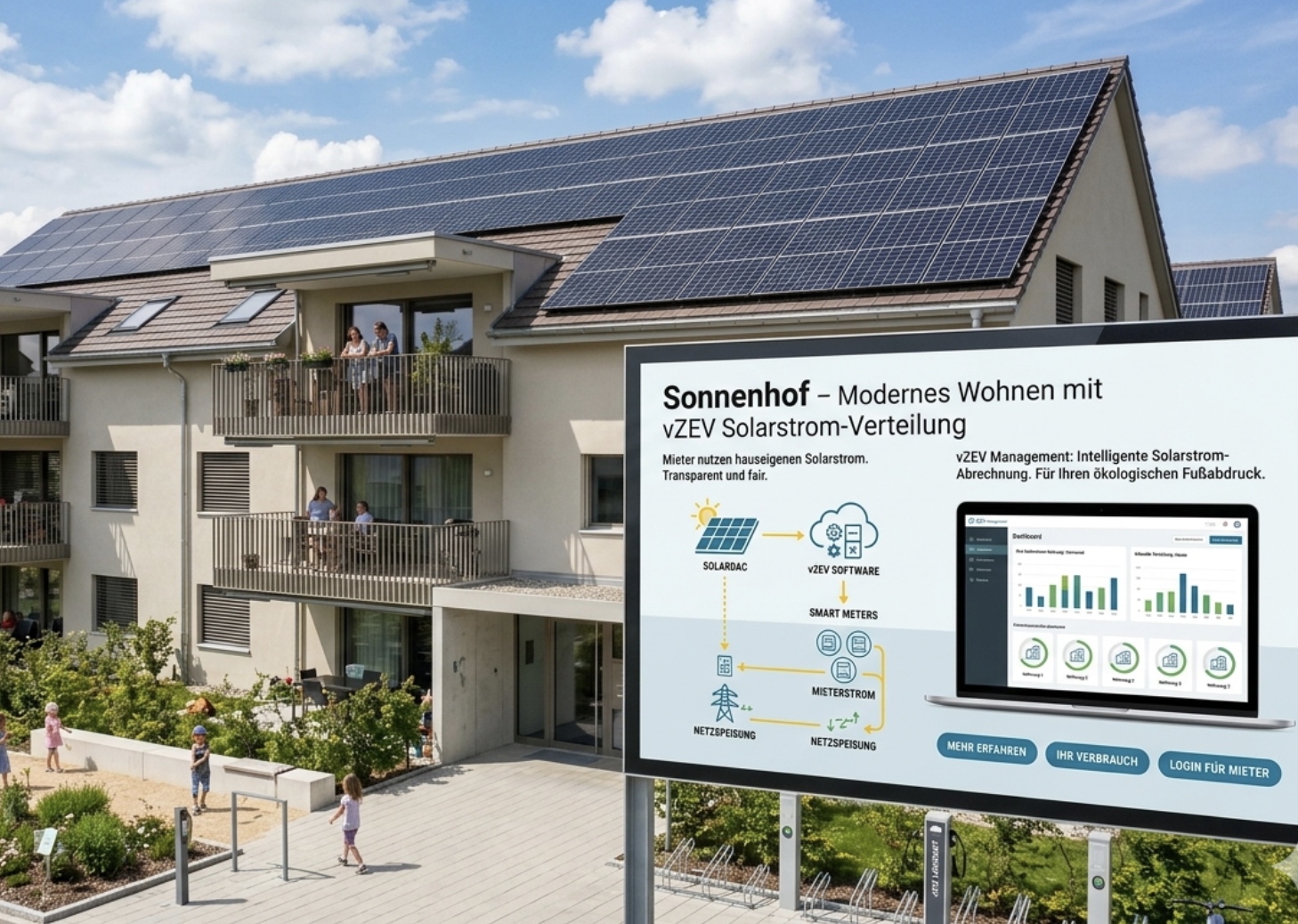
In a self-consumption community (ZEV), solar power is produced locally and shared among the parties. Consumption data from various meters previously had to be manually compiled into error-prone spreadsheets. Based on Swisseldex data, Glue built a lean, standalone dashboard.
“I first built the dashboard for my own solar installation because I no longer wanted to do the billing in Excel. Only afterwards did we realize: the methodology that got us from a personal concern to a working tool in 3 weeks is exactly what our customers need.”— Urs Nacht, Executive Management, Glue AG
Who is Rapid AI Prototyping for?
Whether public administration or private sector: if you have a concrete idea but aren’t yet sure whether it’s worthwhile, a prototype helps you find out quickly.
Decide with confidence before issuing a tender and investing.
Municipalities, cantons, and federally affiliated organizations can test a concrete solution early as a working prototype, while already building a clean, vendor-neutral specification.
Test ideas before investing a lot of time and money.
For SMEs, startups, and established companies: an idea becomes tangible, testable, and presentable in a short time – for customers, employees, executive management, the board, or investors.
A clear path — with a free, no-obligation start.
Idea, show the prototype, gather feedback, refine — over multiple rounds if needed, before it becomes production software. This way, the right solution emerges from the start, rather than through costly adjustments later on.
|
Step 0
Quick assessment
30 min. — we’ll tell you honestly whether custom development makes sense. |
Step 1
Workshop
Half a day — you provide input, we ask questions. |
Step 2
Prototype
A clickable, working tool including one review round with adjustments. |
Step 3
MVP
A production-ready version including one review round with adjustments. |
Step 4
Further development
Sprint-based — only if you want to continue. |
Who is this suitable for?
Ideal for you if…
Not suitable if…
Frequently asked questions.
How quickly do we get a first result?
After the free 30-minute initial assessment, a half-day workshop follows. The prototype (Package 1) is then working within 2–3 weeks — including a recommendation on whether scaling is worthwhile.
What if the prototype shows that the idea doesn’t work?
Then we’ll say so honestly — the go/no-go recommendation is part of Package 1. A “no-go” after a small amount is far cheaper than a “no-go” after a large software project.
Do we need to put this out to public tender?
In many cases, Package 1 can be awarded directly without a tender, since the contract value falls below the relevant thresholds. Whether a tender is required depends on your institution, the subject of the procurement, and the applicable procurement law.
We don’t have our own IT team for this — is that still possible?
Yes. You only need a subject-matter contact person for the workshop and for questions — our senior engineers handle the rest.
Can we also run several prototype rounds before building the MVP?
Yes, absolutely. If new insights emerge after the first round, further prototype iterations can be arranged. This is usually far more economical than building an expensive MVP too early, while the requirements profile can still be sharpened.
What happens to our data?
You decide where your data is processed: cloud, or fully on-premise/Swiss cloud. Sensitive development steps can run via local AI agents in your own infrastructure, without transmitting data to public AI interfaces. Open-source components used remain traceable and auditable, and on request, an SBOM documents all components, versions, and licenses for security clearances and audits.
Free initial assessment — 30 minutes, no obligation.
Book a short initial call directly. Together, we’ll honestly clarify whether your idea is sprint-ready and which package fits your project — with no sales pressure.